Answering 24/7, installs by appointment
Buried Downspout Drain Lines That Move Water Away From Atlanta Foundations
A gutter only moves water to the corner of the house. Where it goes from there decides whether the foundation stays dry.
At a glance
- 24/7
- Calls answered
- Sloped lines
- To daylight or emitters
- Flow tested
- Every run
- Atlanta
- Service office
A downspout drain line in Atlanta is a buried pipe that carries roof water from a downspout to a daylight outlet or pop-up emitter well away from the house. It matters here because the local sand and red clay mix drains slowly, so water dumped at the foundation tends to sit there; a sloped, solid line moves it where it can soak in or run off.
Updated September 2026
The job
Why Splash Blocks Are Not Enough in Clay
Every downspout drops the water from a whole section of roof in one spot. In a heavy storm that is a lot of water landing within a foot of the foundation, and in clay soil it has nowhere quick to go.
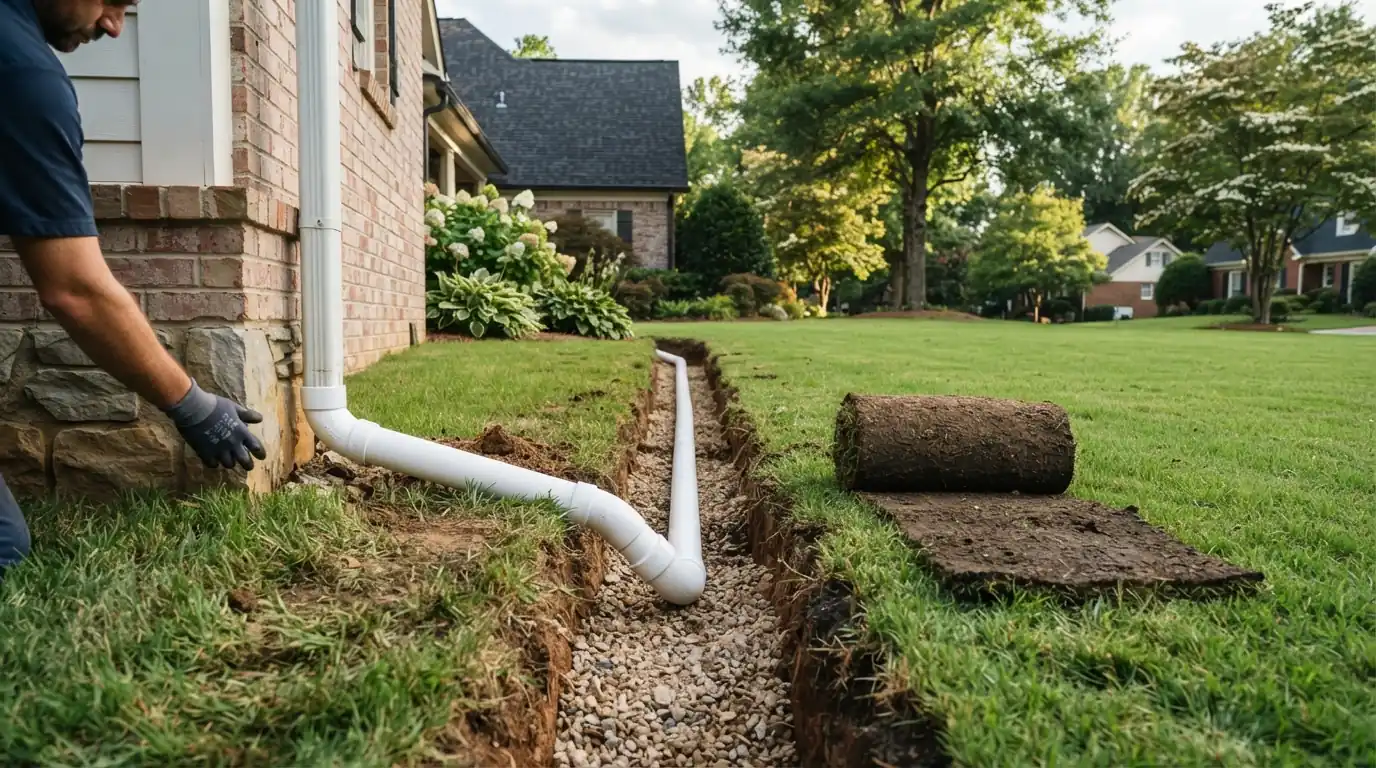
A buried line takes that water underground, on a steady slope, to a point where it can surface safely: a daylight outlet on a slope, a pop-up emitter in the lawn, or the curb where local rules allow. We plan the route around trees, utilities and walkways first.
Your options
Splash Block, Extension or Buried Line
Three ways to handle a downspout, from simplest to most permanent.
| Splash block | Surface extension | Buried drain line | |
|---|---|---|---|
| Moves water | A foot or two | Several feet | To a chosen outlet |
| In the way | No | Yes, on lawns and walks | No |
| Best for | Well-drained, sloped spots | Open lots, temporary fixes | Clay soil, flat lots, finished yards |
What the work covers
Buried Downspout Drain Lines
We dig a trench from each downspout on a consistent downhill slope, lay smooth-wall solid pipe rather than thin corrugated tubing that crushes and traps debris, and connect it to the downspout with a proper adapter and, where useful, a cleanout. Utilities are marked before any digging. The trench is backfilled and the sod replaced. Solid pipe matters: perforated pipe leaks water back into the soil right beside the house, which defeats the purpose of the line. Every joint is glued or clamped so the line stays sealed underground.
Pop-Up Emitters and Daylight Outlets
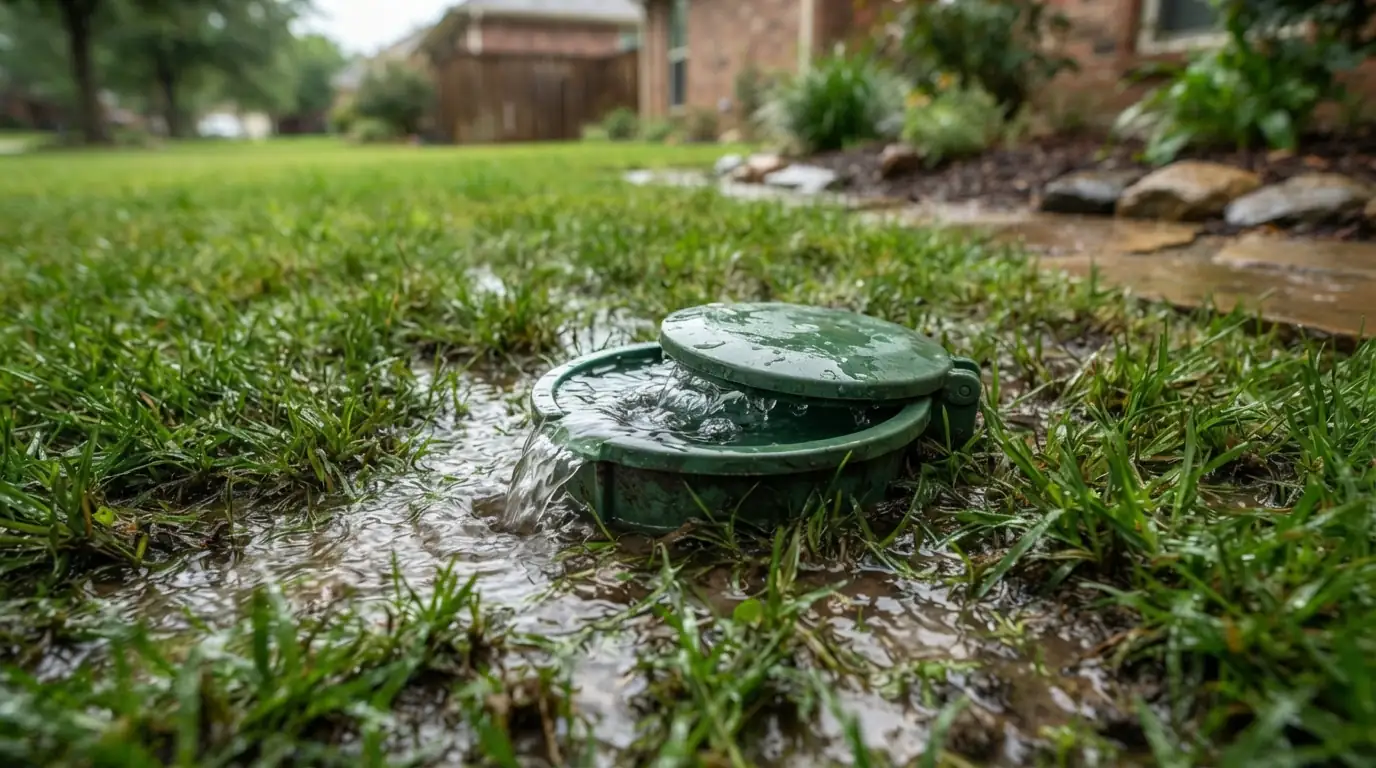
Where the line ends decides how well it works. On a sloped lot, a daylight outlet where the pipe exits the grade is the most reliable end point. On flatter lots, a pop-up emitter lets water rise out of the lawn and closes when flow stops, keeping debris and animals out. We place the outlet far enough from the house, and away from neighbors' property, so the water spreads out instead of pooling somewhere new. Emitters are set flush with the lawn so mowers pass over them.
Clogged Drain Line Repair
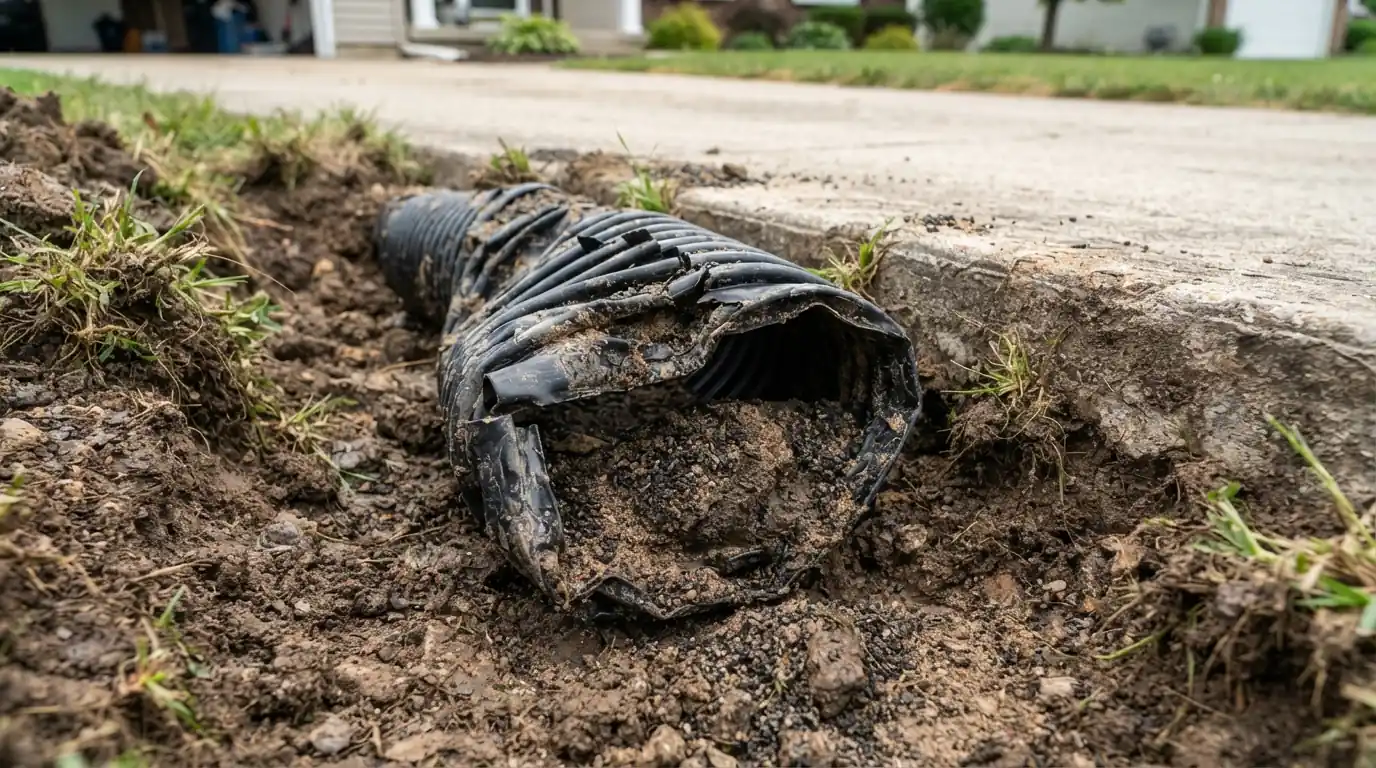
Existing buried lines clog with roof grit, needles and roots, or crush under a driveway edge, and the first sign is a downspout overflowing at the top. We flush the line to find where it is blocked, clear it where it can be cleared, and dig up and replace crushed or root-filled sections. Lines built from corrugated tubing that keeps collapsing are usually worth replacing with solid pipe rather than repairing again. You get photos of the blockage and the route before anything is dug up.
What drives the price
What Drain Line Work Costs Depends On
Drain line work is priced by the length of trench, the number of downspouts and what is in the way.
Trench length
Distance from each downspout to the outlet.
Number of downspouts
Each one connected and sloped.
Obstacles
Roots, walkways and driveways to cross.
Outlet type
Daylight outlet or pop-up emitter.
Pipe type
Solid smooth-wall pipe with cleanouts.
Restoration
Backfill and sod replaced along the trench.
Local conditions
Clay Soil and Heavy Rain in Metro Atlanta
Soil across metro Atlanta is typically a sand and red clay mix that sheds water more slowly than the sandier soils of Florida or South Carolina, so water left at a foundation tends to sit there. With about 50 inches of rain a year, and single storms that can drop an inch of water and overwhelm gutters, where the downspout empties matters as much as the gutter itself.
What is included
What a Drain Line Installation Includes
- Lot walk for slope and outlet options
- Utilities marked before digging
- Trench on a consistent downhill slope
- Solid smooth-wall pipe
- Downspout adapters and cleanouts
- Daylight outlet or pop-up emitter
- Flow test through every connection
- Backfill and sod replaced
- Photos of the route for your records
Step by step
How a Drain Line Installation Runs
- 1
Call to plan it
Tell us where water pools after rain.
- 2
Walk the lot
Slope, outlets, trees and utilities checked.
- 3
Mark utilities
Lines marked before any digging.
- 4
Route and quote
Trench path and outlet in writing.
- 5
Dig and lay pipe
Solid pipe on a steady slope.
- 6
Connect and test
Downspouts connected and flow tested.
- 7
Restore the yard
Trench backfilled and sod replaced.
Questions we hear
Downspout Drain Line Questions
Extensions help on open lots. Where they are in the way or the yard is flat, buried lines work better.
It leaks water into the soil beside the house, which is what the line is meant to prevent.
To a daylight outlet on a slope, a pop-up emitter in the lawn, or the curb where allowed.
The trench is narrow, backfilled and the sod replaced.
Often. We flush it, find the blockage and replace crushed or root-filled sections.
A flush now and then, and clean gutters upstream, keep them flowing.
Our work stops at roof water. Yard-wide groundwater drainage is a landscaping job.
Atlanta, GA service office
1421 Peachtree St NE FL. 3, Atlanta, GA 30361
Talk to a roofer today
Get roof water away from the foundation
Call to plan it. We walk the lot, route the lines and test every downspout before the trench is closed.