Leak calls answered 24/7
Roof Flashing Repair in Atlanta at Chimneys, Walls and Edges
Flashing rarely fails, but when it does it fails in the same few places, and it has usually been caulked at least once already.
At a glance
- 24/7
- Calls answered
- Metal, not caulk
- Every repair
- Kick-outs
- At every wall base
- Atlanta
- Service office
Roof flashing repair in Atlanta covers the metal that seals joints at chimneys, walls, skylights and the roof edge. Published figures put flashing installation at $200 to $500, with chimney and valley work at $800 to $3,000. We replace failed flashing piece by piece and weave it into the shingles instead of caulking over it.
Updated September 2026
Step by step
How a Flashing Repair Runs
- 1
Call about the leak
Tell us where the water shows.
- 2
Inspect the joint
Flashing, mortar, siding and deck.
- 3
Photos and price
Failed metal shown before work.
- 4
Open it up
Shingles and siding removed at the joint.
- 5
New flashing
Steps, counter, apron or drip edge.
- 6
Seal and reset
Reglet sealed, siding and shingles back.
- 7
Water test
Hose test on the repaired joint.
Signs to watch for
Signs of Failed Roof Flashing
Stains near the chimney
Water getting past the flashing or crown.
Rust streaks on flashing
The metal is wearing through.
Caulk smeared on joints
A past patch that will crack again.
Rotted siding at a roof line
Missing step flashing or kick-out.
Fascia rot along the eaves
Missing or misplaced drip edge.
The job
Where Flashing Fails and Why Caulk Does Not Fix It
Flashing is sheet metal that turns water away wherever the roof meets something else. When it fails, it is usually the uphill side of a chimney, the step flashing along a wall, or the drip edge along the eaves.
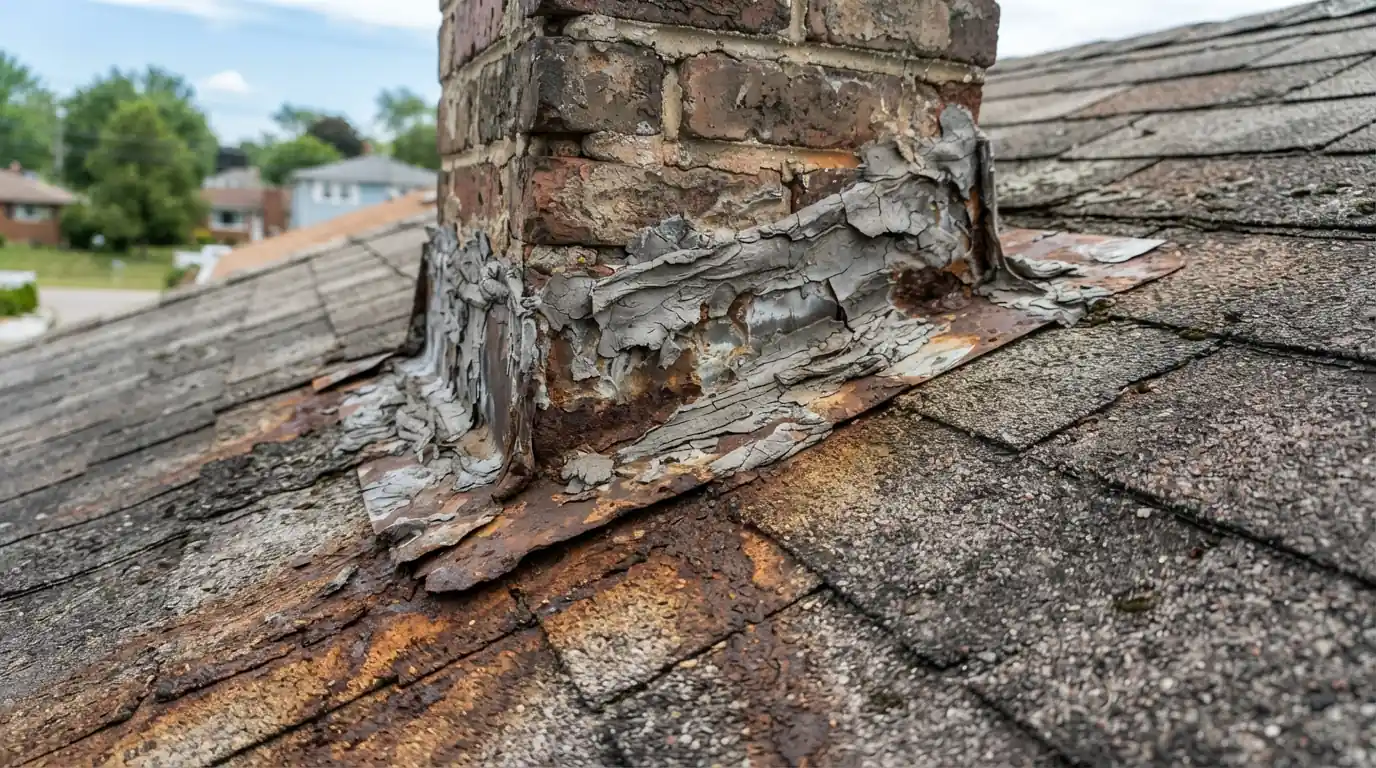
By the time a flashing leak is found, the joint has often been caulked already. Sealant hides it for a season and then cracks, so the repair is metal done correctly: step flashing woven course by course, counter flashing let into the masonry, and a cricket where water dams.
What the work covers
Chimney Flashing Repair
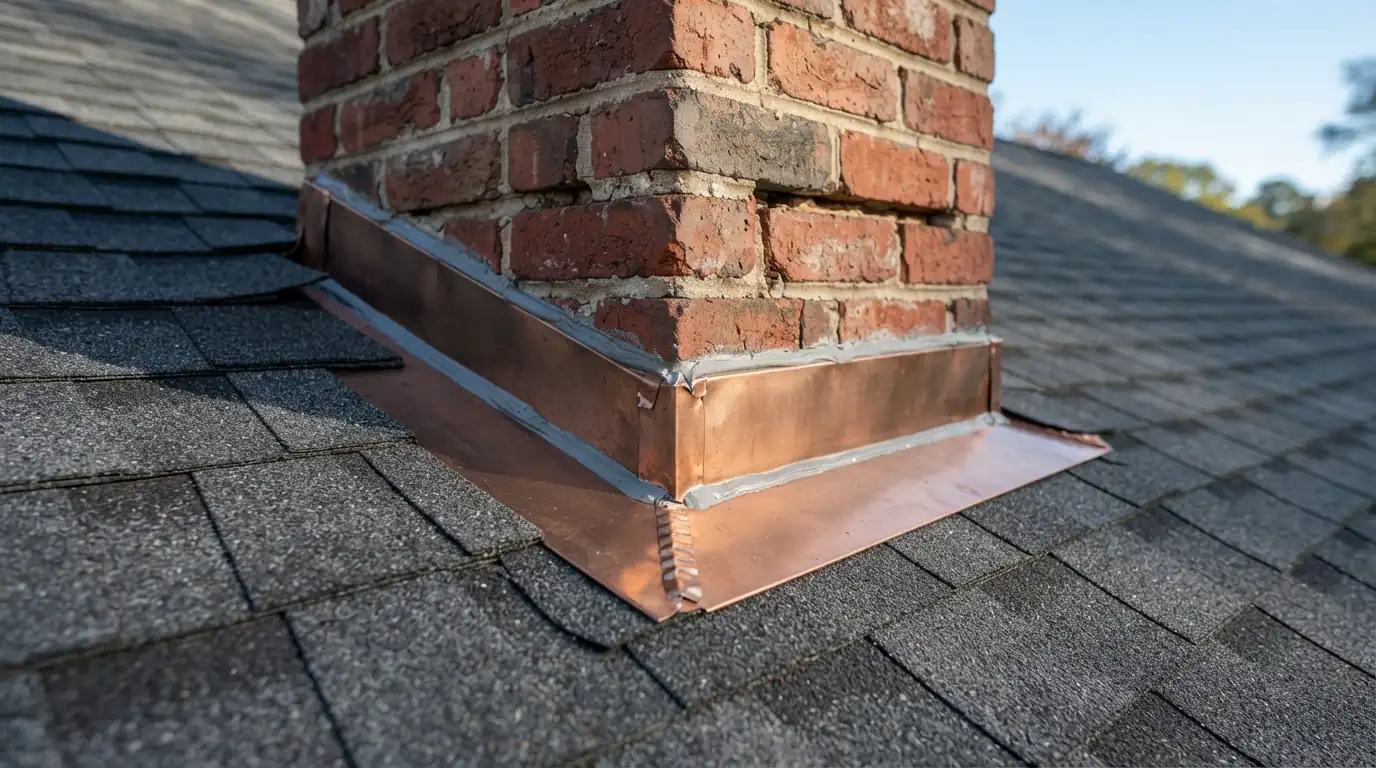
A chimney needs four kinds of flashing: an apron on the downhill face, step flashing woven into the shingles on both sides, counter flashing cut into the mortar joints and lapped over the steps, and a cricket or back pan on the uphill side of wider chimneys. Leaks usually come from counter flashing pulled out of loose mortar, or a missing cricket where debris piles up. We cut a fresh reglet into sound brick, set new counter flashing and seal the reglet.
Step and Wall Flashing
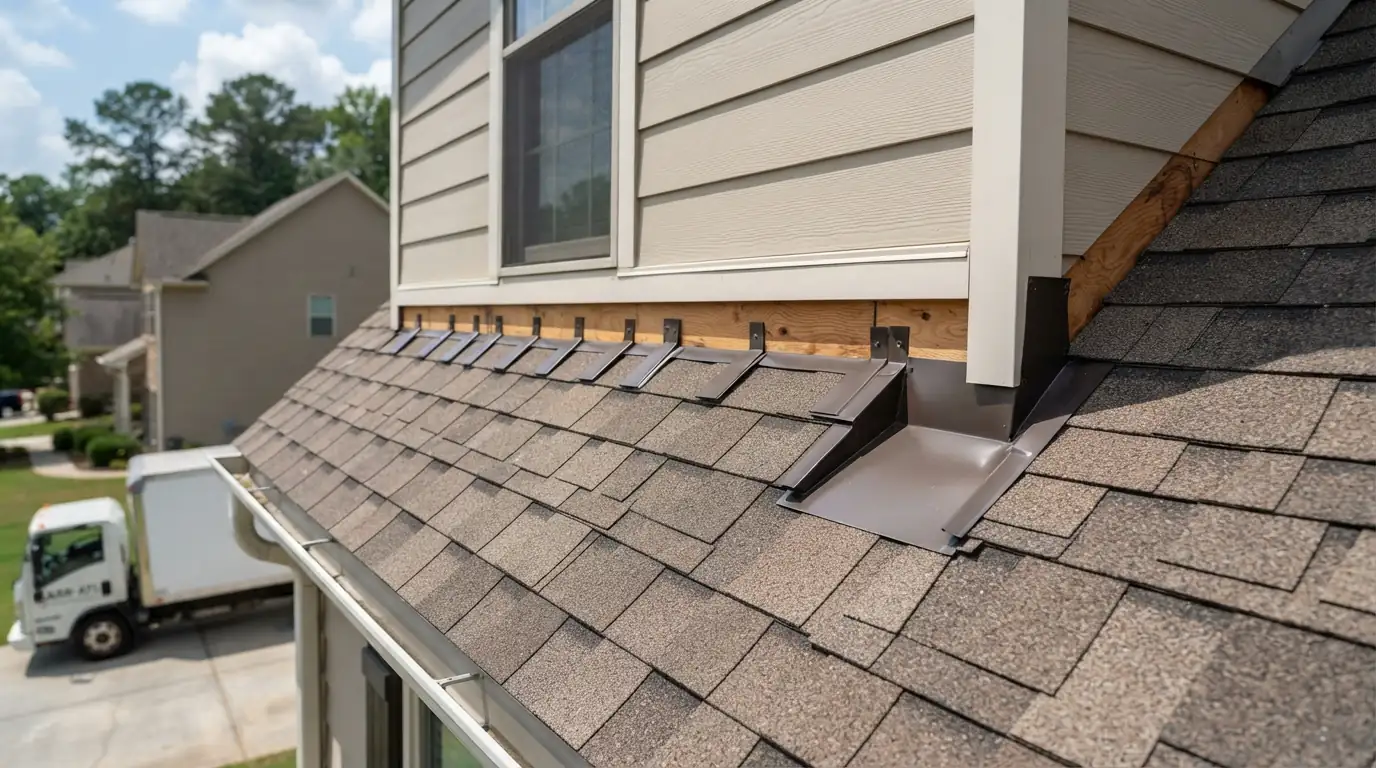
Where a roof runs into a sidewall or a second story, every shingle course needs its own L-shaped step flashing tucked behind the siding. Skipped steps, one long bent piece, or flashing held only by caulk all let water run down inside the wall, where it rots sheathing before anyone sees it. We remove siding at the joint, install step flashing course by course, add a kick-out at the bottom so water lands in the gutter, and reset the siding.
Drip Edge Replacement
Drip edge is the metal strip along the eaves and rakes that carries water into the gutter instead of letting it wick back onto the fascia. Many older roofs never had it, or it was lapped the wrong way against the underlayment. We install or replace drip edge in the right sequence, under the underlayment at the eaves and over it at the rakes, lap its joints, and set it so the gutter's back edge sits behind it. That stops the rot that starts at the top of the fascia.
Local conditions
Old Brick Chimneys on Atlanta's Intown Streets
West End houses mostly date from 1870 to 1930, and chimneys that old sit in lime-based mortar that softens over the decades. Counter flashing set into soft joints works loose unless the reglet is cut fresh into sound brick. On Atlanta's older intown streets, a chimney leak is more often a flashing and mortar problem than a roof problem, and fixing the metal properly usually ends it.
DIY or call a roofer
Caulking a Joint Versus Replacing the Flashing
Caulk is the usual DIY flashing fix. It buys a season.
| Doing it yourself | Having us do it | |
|---|---|---|
| Chimney joint | Caulk along the brick | New counter flashing in a cut reglet |
| Wall joint | Sealant over the gap | Step flashing behind the siding |
| Bottom of a wall | Left as is | Kick-out flashing into the gutter |
| How long it lasts | Until the caulk cracks | As long as the roof around it |
Water showing up beside the chimney after every storm? Call and we will open the flashing and fix it right.
Call to fix itWhat drives the price
What Flashing Repair Costs
Published figures put flashing installation at $200 to $500, and chimney, valley or larger flashing repairs at $800 to $3,000. Planning ranges, not our quote.
Location
Chimney, wall, skylight or eave.
Masonry work
Reglets cut and mortar repointed.
Siding removal
Pulled and reset at wall joints.
Cricket
Added behind wide chimneys.
Hidden rot
Sheathing or wall damage found.
Pitch and height
Steep roofs take more setup.
Questions we hear
Flashing Repair Questions
Small loose pieces can be reset; rusted or missing flashing is replaced.
Usually the uphill side. Water dams behind a chimney that has no cricket.
It can be either. Cracked crowns and porous brick leak too, so we check both.
Where the flashing sits, yes. Full chimney rebuilds are a mason's job.
A bent piece at the bottom of a wall that sends water into the gutter instead of down the siding.
It should. Reusing old flashing under new shingles is a common shortcut.
Most are done in one visit, including resetting siding or repointing the reglet.
Atlanta, GA service office
1421 Peachtree St NE FL. 3, Atlanta, GA 30361
Talk to a roofer today
Replace the flashing, not the caulk
Call and tell us where the water shows. We will open the joint, replace the failed metal and water test it before we leave.