Answering 24/7, installs by appointment
New Gutter Installation in Atlanta, Sized for Heavy Rain
Most overflowing gutters are not dirty. They are too small for the roof above them, or they have too few downspouts.
At a glance
- 24/7
- Calls answered
- 5 or 6 inch
- Sized to the roof
- Hidden hangers
- Into rafter tails
- Atlanta
- Service office
Gutter installation in Atlanta usually means seamless aluminum formed on site in one continuous run per wall, in 5-inch or 6-inch profiles. We size the gutter to the roof area draining into it, place downspouts so no run carries too much water, and hang it on hidden hangers pitched toward each outlet.
Updated September 2026
The job
Why New Gutters Still Overflow When They Are Undersized
Most gutter problems come from undersizing and too few downspouts. A long valley can dump more water into one corner than a 5-inch gutter can move, and it overflows every storm no matter how clean it is.
We look at the roof above each run before quoting: how much area drains to it, where valleys concentrate water, and where downspouts can discharge away from the foundation. Gutters come down during a roof replacement, so replacing both together saves a second setup.
Your options
5-Inch or 6-Inch Gutters
Both are K-style seamless aluminum. Roof area, pitch and trees decide the size.
| 5-inch K-style | 6-inch K-style | |
|---|---|---|
| Capacity | Suits most single-story roofs | Carries noticeably more water |
| Downspouts | 2 by 3 inch | 3 by 4 inch |
| Debris | Clogs sooner under pines | Passes needles and seed pods |
| Best fit | Short runs, low pitch | Steep roofs, long runs, heavy trees |
What the work covers
Seamless Aluminum Gutters
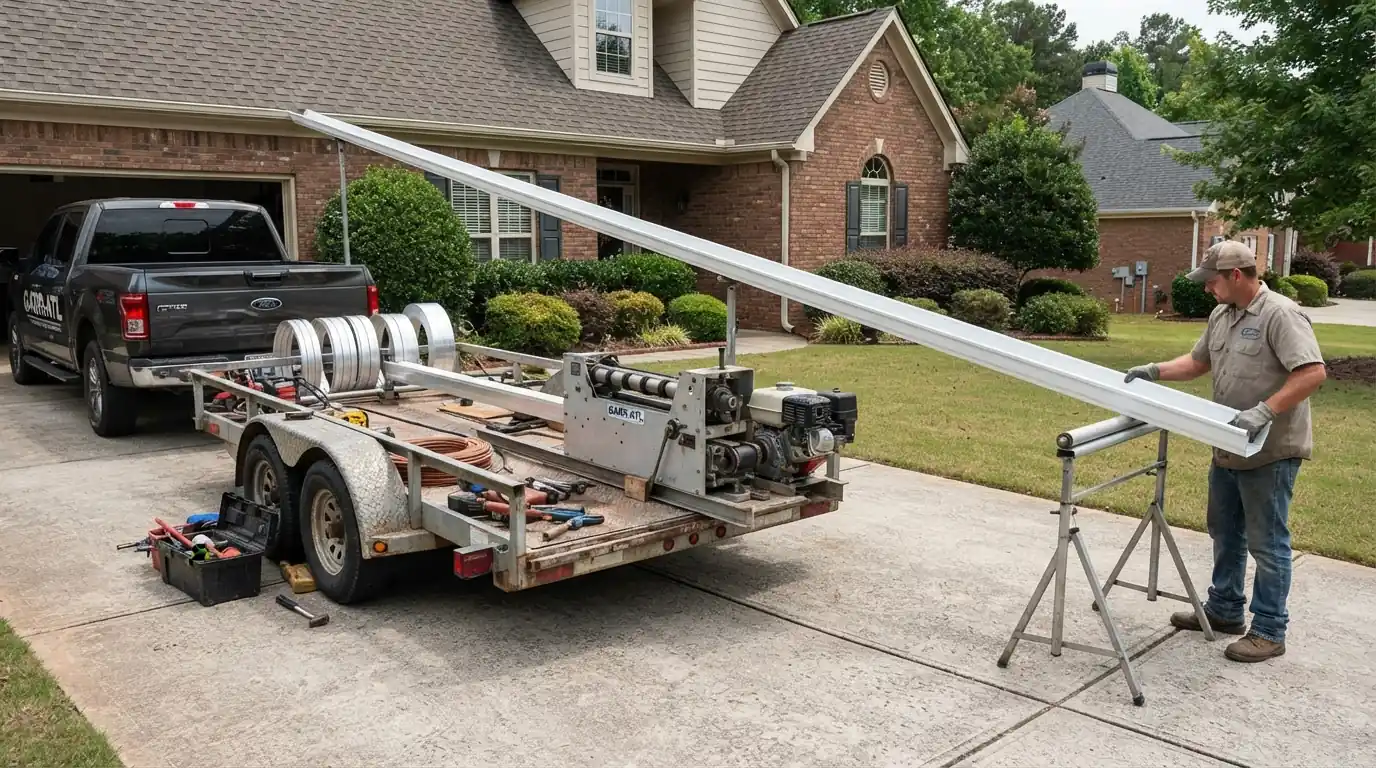
Seamless gutters are formed from a coil of aluminum by a machine on site, cut to the exact length of each wall. With joints only at corners and outlets, there are far fewer places to leak than on sectional gutters joined every ten feet. We hang them on hidden hangers screwed into the rafter tails, tuck the back edge under the drip edge so water cannot run behind, and seal the corners and end caps. Colors are chosen to match the trim or fascia.
6-Inch Oversized Gutters
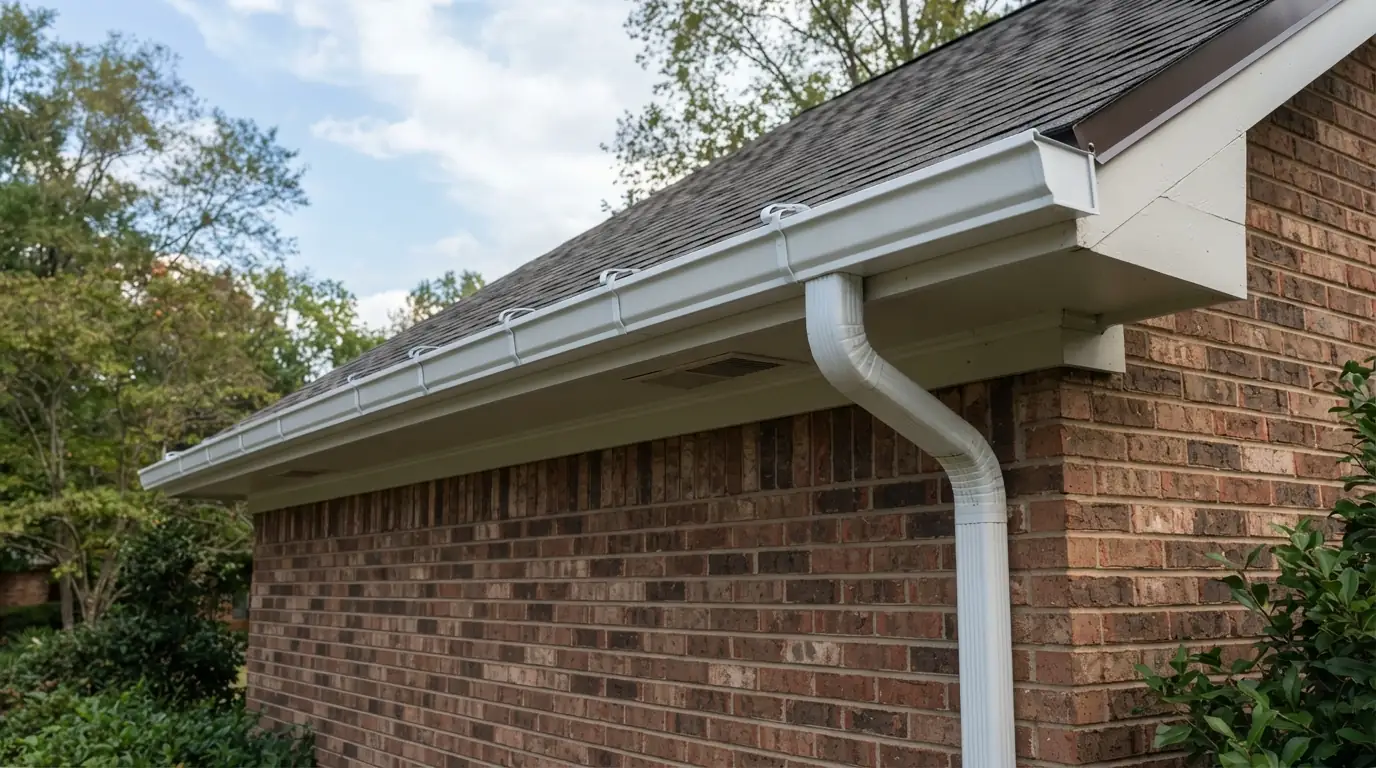
A 6-inch gutter carries noticeably more water than a 5-inch one and pairs with larger 3 by 4 inch downspouts that pass pine needles and seed pods instead of clogging. It is the right choice for steep roofs, long runs, corners where two valleys meet, and heavily treed lots. The larger profile also looks proportional on a two-story house. On a small ranch with short runs, 5-inch is usually enough, and we will tell you so rather than upsize it.
Downspout Layout and Extensions
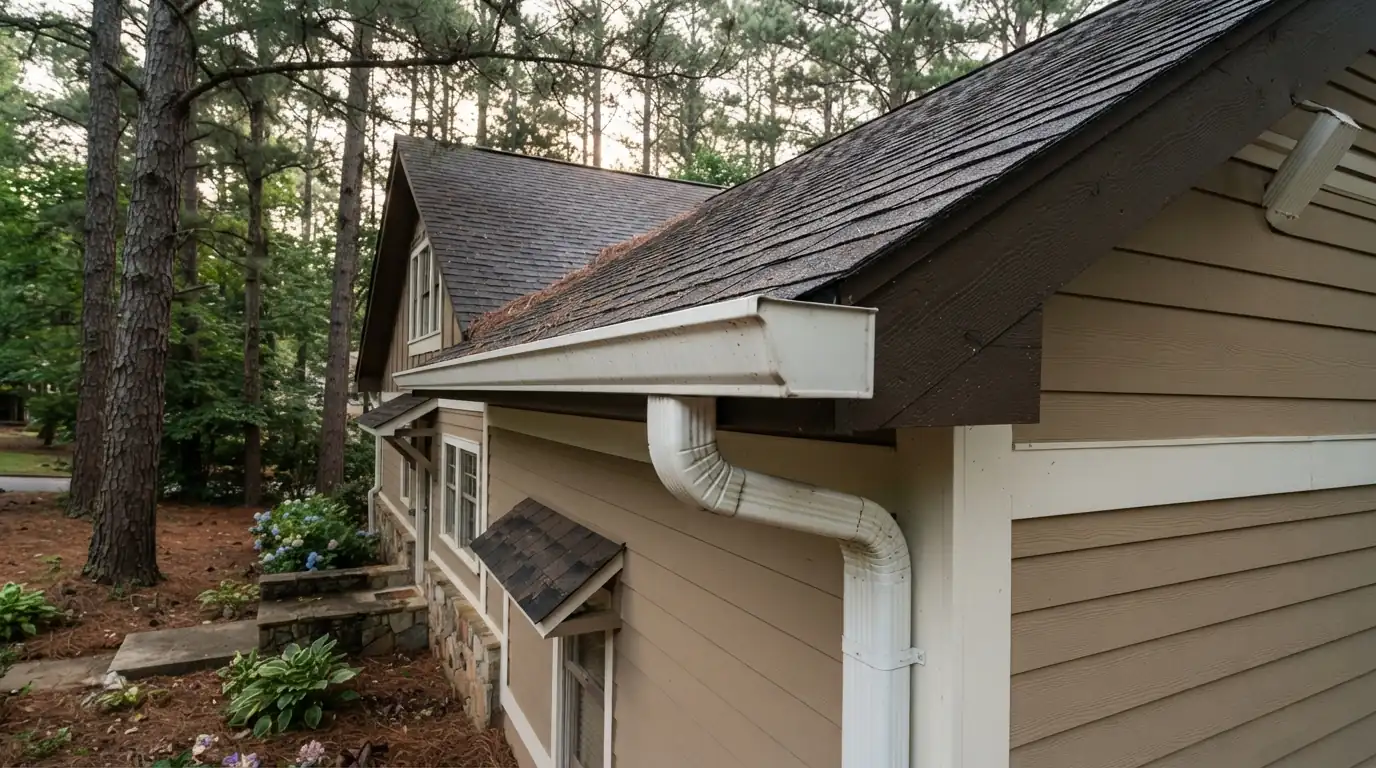
Downspout placement decides whether a gutter works. We place outlets so no run carries water too far, add a downspout at corners where valleys concentrate flow, and keep them clear of walkways and doors where possible. At the bottom, water is carried away from the foundation with extensions, splash blocks or a connection to an existing underground drain that has been flushed and tested. Downspouts are strapped tight to the wall so storms cannot shake them loose, every few feet of their length.
What drives the price
What New Gutters Cost Depends On
Gutters are priced by the linear foot, with size and height driving most of the difference.
Linear feet
Total run across every eave.
Size
6-inch costs more than 5-inch per foot.
Stories
Second-story runs need more setup.
Downspouts
Count, length and extensions.
Old gutter removal
Tear-off and haul-away.
Fascia repair
Soft boards fixed before hanging.
Local conditions
Atlanta Trees and the Case for Bigger Downspouts
With roughly 3.7 million trees in the city and loblolly pine the most common, Atlanta gutters carry a steady load of needles and spiny sweetgum balls along with the rain. That is the practical case for larger outlets: a 3 by 4 inch downspout passes debris that jams a 2 by 3, and fewer clogs means fewer overflows at the corners. On lots shaded mostly by pines, we size up unless the runs are short.
What is included
What a Gutter Installation Includes
- Removal and haul-off of old gutters
- Fascia checked and soft boards repaired
- Drip edge checked so water enters the gutter
- Seamless runs formed to length on site
- Hidden hangers into the rafter tails
- Pitch set toward every outlet
- Sealed corners, end caps and outlets
- Downspouts strapped, with extensions or splash blocks
- Water test through every downspout
Step by step
How a Gutter Installation Runs
- 1
Book a visit
Tell us where gutters overflow or leak.
- 2
Measure the roof
Drainage area, valleys and runs.
- 3
Size and layout
Gutter size and downspout spots set.
- 4
Remove the old
Old gutters down, fascia checked.
- 5
Form and hang
Seamless runs formed and hung.
- 6
Seal and connect
Corners, outlets and downspouts.
- 7
Water test
A hose run through every downspout.
Questions we hear
Gutter Installation Questions
It depends on roof area, pitch and trees. Steep roofs, long runs and pine-heavy lots usually need 6-inch.
Fewer joints means fewer leaks. Seamless runs only have seams at corners and outlets.
Yes. Seamless aluminum comes in a range of standard colors to match trim or fascia.
If they are old, yes. They come down anyway and go back up with fresh drip edge.
Yes. See gutter guards for mesh and hood options.
Away from the foundation: onto a splash block, an extension or a tested underground drain.
Most single-family homes are finished in one day.
Related work
Gutter Work That Pairs With New Gutters
Atlanta, GA service office
1421 Peachtree St NE FL. 3, Atlanta, GA 30361
Talk to a roofer today
Gutters that keep up with Atlanta rain
Call to book a visit. We will measure the roof above each run and quote the size and layout that will actually carry the water.